

This is a building-in-public series. I’m documenting what it actually looks like to design and execute a community-led go-to-market strategy from the ground up: the frameworks, the surprises, the things that break, the things that work. No retroactive case study polish. Just field notes from someone who wrote the book and is now pressure-testing every chapter.
I spent three months listening before I built anything.
Not listening in the way companies usually mean (a survey, a focus group, a deck of “customer insights” assembled from a safe distance). I mean calling someone you’ve never met, asking them about their lives, and then shutting up for forty-five minutes while they share real stories and struggles.
Ironically, I was doing the exact thing their passengers never do. Well… I used to be the one in the backseat pouring my heart out to a very kind and patient driver. Now the tables have turned.
I’m a fractional Head of GTM at GigU, a data intelligence platform for gig economy drivers: the people driving your Uber, delivering your DoorDash, moving through cities in ways that are invisible to most of us until we need a ride.
GigU helps them make smarter decisions about which rides to accept by surfacing the information that platforms deliberately withhold. Think of it as a copilot: not telling drivers what to do, but giving them the intelligence to decide for themselves.
When I came on board, the product already worked.
Drivers who used it consistently were earning more, driving smarter, feeling more in control. The question wasn’t do we have PMF? It was: how do you build a growth engine for a product that serves a population the tech industry has systematically overlooked?
My answer, always, is community. Not as a marketing channel.
Community as a value creation engine.
Here’s what that means, and what I’m learning as I build it.
The first rule: listen before you architect
In Hacking Communities, I write about the Seed stage of the dandelion lifecycle: the idea that before you build outward, you have to find your core.
In a company context, that core lives not only in the founding team’s values manifesto, but mainly in your users’ lived experience: a fusion that solidifies your raison d’être. Or purpose, in good plain English.
You cannot build belonging for people you can’t relate to.
So before designing a single strategy document, I picked up the phone, set up a spreadsheet, and started calling gig drivers across multiple U.S. markets. (The fancy term is “qualitative discovery interviews.” The real term is listening.)
Not screened leads. Not power users. Just drivers. People in airport lots. People between deliveries. People who’d been driving for six months and people who’d been driving for six years.
I asked open-ended questions and let them talk.
What emerged was not a predictable report from dozens of conversations, but patterns. Four distinct behavioral personas. Not demographic segments (we deliberately don’t segment by ethnicity or background), but patterns of motivation and economic relationship to the work.
Some drivers treat the gig like a game to be optimized.
Some are surviving, and need tools that work out of the box without a learning curve.
Some chose this work for the flexibility and feel overwhelmed by the complexity.
Some are experimenters who love trying every new tool.
These personas don’t just tell you who to market to.
They tell you how each person needs to feel welcomed, supported, and respected at every stage of their journey. That’s the foundation of community design, not marketing segmentation.
No plan survives first contact, and that’s fine
A strategy is not a finished product. It’s a living system being tested against reality, which is already teaching what the research couldn’t.
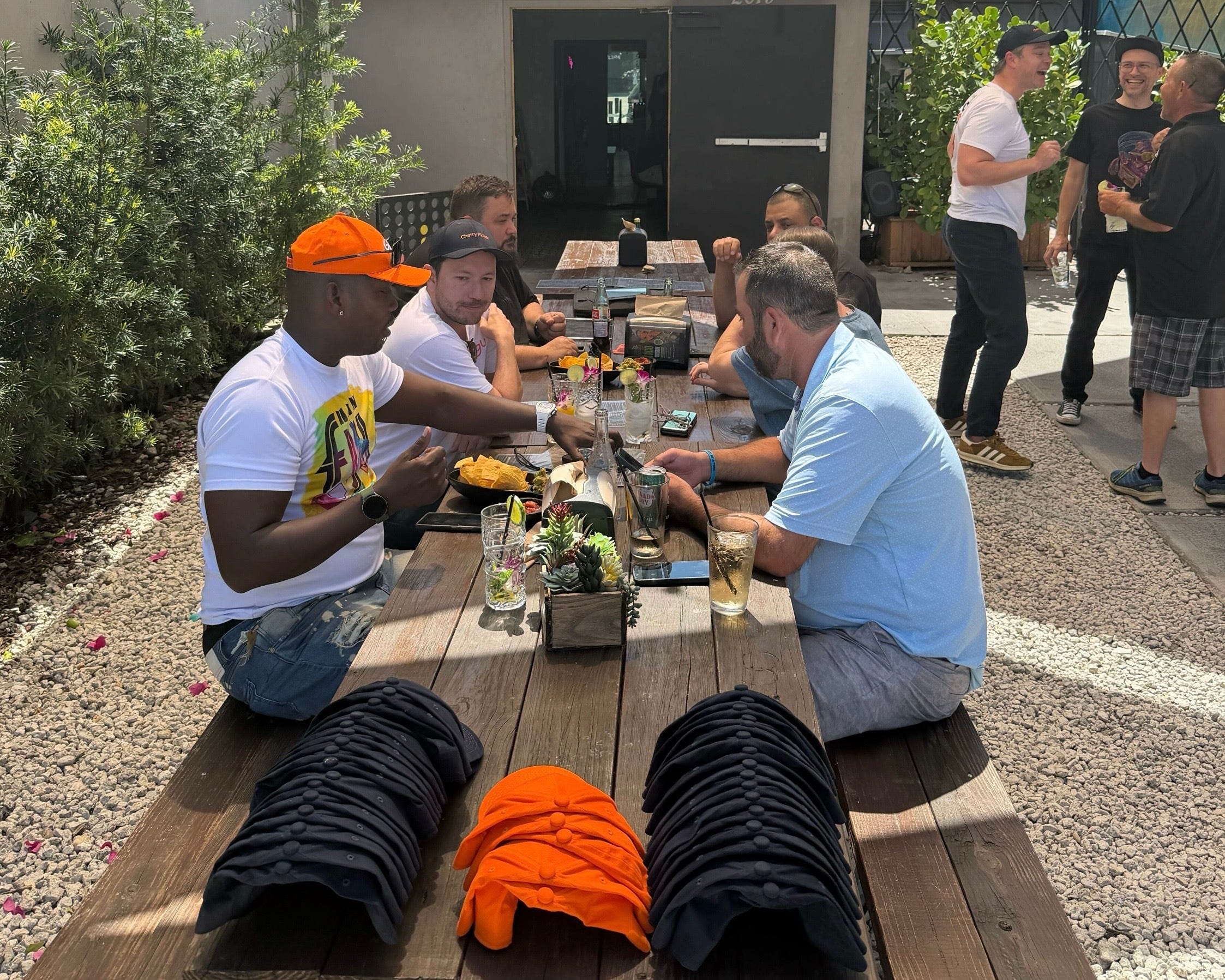
So we hosted our first event in Miami.
But first, let me tell you about all the homework. I had designed the frameworks, mapped a complete driver lifecycle — from someone who’s never heard of GigU to someone who can’t imagine driving without it — and layered it against awareness and archetypal stages so that every touchpoint has a purpose, not just a metric… Oh, and I had pressed it against a community architecture with distinct participation pathways, each running on the same fractal infrastructure. I built the whole thing on the Lighthouse/Port/City model from my book: attract, engage, commit. Smarty pants overdoing it much.
But the architecture is not the work.
The work is what happens when you actually show up.
So, we hosted our first driver event in Miami.
We stood in a room with people whose livelihoods depend on decisions they make in two-second windows, listening to them debate which rides are worth taking and which ones aren’t.
We watched drivers who’d never met exchange phone numbers because they realized they drive the same neighborhoods and could share intelligence.
We heard them ask us: “So, when is the next meetup?”
That let’s do this again moment.
That moment is not a KPI.
That’s the entire point.
Everything we designed is in service of making that moment happen more often, more reliably, across more cities.
When community isn’t an afterthought but an engine
Here’s where GigU’s story diverges from the typical community-led growth playbook.
For most products, community supports growth: referrals, advocacy, retention. Yes, those outcomes matter. But for GigU, community isn’t just a growth layer. It supports the delivery of our key value proposition. It’s an intelligence layer.
As I’ve written before: the strongest community-led businesses — Waze, Duolingo — skyrocket when community isn’t an accessory, but a fundamental part of their value creation engine.
GigU is a data intelligence platform. The smarter the data model gets, the better it serves every driver. And the data model gets smarter through use: every driver who engages with the tool contributes to a sharper picture of what’s really happening on the road.
From a product standpoint, this creates a compounding effect: the more drivers who participate in a given area, the more valuable the intelligence becomes for everyone in that area. And as research led by Columbia Business School professor Len Sherman points out, the more a driver makes intentional choices about their rides, the more they train the algorithm to send them better offers.
From a social perspective, this creates something even more powerful: a belief network where drivers understand how their behavior shapes their reality. By choosing which rides are worth taking, I’m making the most of my time and training the algorithm to respect me.
Community is the mechanism that makes this compounding effect real.
When drivers feel ownership over the tool, they use it more deeply, share more feedback, and recruit others into their local ecosystem. Individual earnings improve because the algorithm improves. The intelligence improves because the community grows. The community grows because the intelligence improves. Collective earnings improve because the community grows.
Aka: how to build a virtuous cycle, 101.
This is what I mean by community as a value creation engine. It’s not a feel-good layer on top of the product. It is load-bearing.
Without it, you have a tool.
With it, you have a movement — and a movement that makes itself smarter every day.
Hyperlocal or nothing
One of the strongest convictions from the research: community density beats community breadth. Every single time.
The gig economy is inherently local. A driver in Miami and a driver in Houston operate in completely different worlds: different traffic patterns, different demand cycles, different airport lots, different economics.
A national community of gig drivers is a content channel.
A hyperlocal community of drivers who share the same streets is a network that changes how people think, behave, and earn.
So we’re building one city at a time. Not scaling nationally and hoping for the best. We’re seeding locally, planting roots deep, and tending to them until the local community can sustain itself without us holding it up.
This is what I call the dandelion model — the backbone of Part II of Hacking Communities.
Each city is its own seed, carrying the same core DNA (values, infrastructure, systems) but growing in its own soil, at its own pace. When it’s strong enough, it produces seeds of its own. Like fractals, where the smallest part represents the whole.
That’s how movements scale: not by broadcasting, but by replicating a pattern that’s proven locally.
The test isn’t “how many cities are we in?”
It’s “are our drivers earning better as a collective? And by the way — do they know each other by name?”
Rethinking conquest in the age of community: veni, vidi, redii
In my book, I describe three stages of community depth:
Lighthouse: you’re a beacon. People discover you from a distance. They hear it from a friend, or a trusted channel. You haven’t asked for anything. You’ve just put something into the world that makes someone feel seen. They think: that’s for me.
Port: they came. They saw. They come back. Not because you asked, but because something resonated. Something spoke for them. A feeling that these people get it. That they are not alone. Because they felt safer here. The port is where belonging starts to form.
City: they claim ownership. The community becomes part of their identity. They don’t just participate — they help to build. They represent it. They provide feedback, facilitate connections, and welcome newcomers. They carry the DNA of the community outward.
I wrote it from practice. But here’s what I’m relearning by bringing it back to real people:
The Lighthouse isn’t a single channel. It’s every moment a driver sees themselves reflected in something GigU puts into the world. A story from another driver who sounds like them. A piece of data that validates what they’ve always suspected. A conversation in a parking lot where someone says, “there’s this tool...”
The Port is where things get real. And harder. Because it requires consistency. It requires showing up at a predictable cadence, in the same way, building familiarity through repetition. In community building, I call this the 3 Cs: Consistency, Cadence, and Cohesion. Monthly meetups. Active local groups. The steady rhythm of presence that turns “I tried this app” into “I can’t drive without it.”
This is also where the critical product transformation happens: the moment a driver goes from casually using GigU to integrating it into how they work every day. That’s when minds shift, habits form, and an overwhelmed beginner crosses the threshold into becoming a local strategist. The hero’s journey, played out on real roads.
The City is why we do it all. The moment they commit. They represent. They belong.
We’re not there yet. Early innings. But we have early signals. Drivers who’ve showed up because GigU has become indispensable. Who started recruiting others. One who volunteered to test new features before we even asked. Another who said, “I want to help organize the next meetup in my area.”
These are seeds. I know to tend to them, but not to rush them.
The trailblazer’s guide to customer development
There’s a memorable Steve Blank line: no business plan survives first contact with customers. We don’t need Taylor’s version. Just replace “business plan” with “community strategy.” And add: that’s fine.
The qualitative research gave me a navigation map. The first events gave me more precise coordinates. The ongoing conversations gave me clear landmarks. This is not failure. This is how you write a map to uncharted lands.
Done right, community-led growth is customer development that never stops.
Every meetup is a listening session. Every group message is signal. Every driver who tells you “this doesn’t work for me...” is handing you the blueprint for what will.
The difference between community-led growth and traditional growth marketing is behavioral.
Traditional growth assumes you know what to say and optimizes how to say it louder. Community-led growth assumes the people you serve know things you don’t — and builds systems that surface that knowledge continuously.
At GigU, this means the community isn’t just a distribution channel for the product.
Community is the product’s nervous system. The feedback loops between drivers and the product team are not a nice-to-have, but how the intelligence layer gets built.
What I don’t know yet
Building in public means unabashedly telling the truth about what’s unresolved. Here’s a raw list:
The right cadence. Monthly meetups feel right, but the days between meetups are where belonging either solidifies or evaporates. We’re experimenting with the connective tissue — group chats, async touchpoints, the small acts that keep the feeling alive between gatherings.
How the model translates across cities. Miami is not Austin, neither is Houston. The research surfaced universal truths about what drivers need, but the texture of community — who shows up, how they relate, and what matters locally — can only be learned by being there.
The pace. Instinctively, startups move fast, break things. But community will scold you for trying to scale before foundations are set. It’s like inviting people to move in before you’ve even had a coffee date. Relationships take time. I’d rather have three cities where drivers genuinely belong than thirty ghost towns with Slack channels.
The metrics. There are evidence-based KPIs. But the most important signal right now is anecdotal: two strangers exchanging phone numbers and asking when’s the next meetup. I’m learning to hold both: what we can measure and what feels relevant.
The mission underneath
Here’s what I do know.
The gig economy serves 1.7 million rideshare drivers in the U.S. alone. Navigating a system designed to keep them in the dark about their own economics. The information asymmetry is structural, and it’s seemingly by design.
GigU exists to restore informational balance. To give drivers the intelligence to make decisions that serve their own interests. That’s a technology problem. But it’s also a dignity problem. And dignity doesn’t scale through ads. But it might scale through community — through people seeing themselves in each other’s stories, trusting each other’s intelligence, and building something together that none of them could build alone.
That’s what we’re working on. These are early days. The plan will keep changing. The mission won’t.
I called my book Hacking Communities because the hack was never a shortcut. It was cracking the code. And the code, it turns out, is personal. You become someone who belongs at home with yourself first — and build from that space. What I keep learning, from parking lots in Miami to picnic tables where strangers become allies, is that no framework replaces that.
You build a home. You make it safe. And then you let them in.
Hi! I’m Laís. My name means “of the people” in Greek. I took it literally. I’m a a community-led growth strategist and author of Hacking Communities: Cracking the Code to Vibrant Communities. She currently serves as Fractional Head of GTM at GigU. Migrant, mother, former law school dropout. 15 years building community-led growth systems across four continents, from startup ecosystems in Southeast Asia to gig economy drivers in Miami.
This is the first installment of a building-in-public series documenting community-led growth in the field. Part of the Hacking Communities project: a book, a practice, and an ongoing conversation about what it takes to build belonging that lasts.
Follow the series at hackingcommunities.com.
If this resonated, share it with someone building community!