

Customer success isn’t a function downstream of go-to-market: it is the whole deal.
The more intricate someone’s journey to solving their problem, the more it becomes part of who they are. The hurdles build character. The journey builds identity. And identity, eventually, becomes movement.
That’s when community-led growth becomes possible.
A person who’s reached the end of your brand journey, who walked the whole arc from I didn’t know I had a problem to I’m thriving and I want others to find this too, is the engine of community-led growth.
But a worthwhile journey is more intricate than A to B.
This piece proposes a five-stage customer success lifecycle, read through three lenses at once: tarot archetypes for the story (what’s happening to them), Eugene Schwartz’s awareness levels for the cognition (what they’re ready to hear), and Closeness Circles for the relationship (how close they are to the people who already get it).
Three readings of one journey. All three move outward to inward.
TL;DR: Identity is forged in walking. There’s no shortcut.
This piece is about how to design for that.
Editorial Note: This piece extends an argument I made earlier: the strongest community-led businesses skyrocket when community isn’t an accessory, but fundamental to their value creation engine. It’s also part of a series: “Field Notes: Building a Community-Led Growth Engine from the Ground Up.” Read first post here.
Notes from the Field: Why the Gig Economy Makes This Visible
The gig economy is the cleanest place I’ve found to watch this dynamic move in real time, because the journey is built into the infrastructure — by design.
Here’s what’s happening to a US gig driver right now. Between December 2024 and December 2025, the customer price per trip rose 9.6%, the platform fee per trip rose 33.2%, and the driver’s gross pay per trip rose 3.6%. The pie is growing. The driver’s slice is shrinking. Only 31% of drivers say they’re satisfied with their earnings, and 44% of the country’s 1.7 million rideshare drivers cite unpredictable earnings as the single biggest challenge of the work.1
That last word matters. Unpredictable. It’s not just the work that’s hard. It’s that the math is hidden. The driver can’t see why one trip pays and the next one doesn’t. He can’t see what the platform took. He can’t see what changed when the algorithm updated overnight. He’s running a small business with no books.
The plot twist: the algorithm benefits from drivers staying that way. A high turnover rate keeps an ever-renewing flock who don’t know how the system works but still hope it will let them earn flexibly. They accept every trip, however poorly it pays. This isn’t a phase the platform wants drivers to grow out of. It’s the phase the platform was optimized to keep them in.
To say it plainly: gig economy platforms invest little in their drivers’ customer success. By design. But GigU is built to be exactly that — the success layer the platforms are missing. (Disclaimer: I’m helping GigU with their community-led GTM2.)
Enter: the Gig Economy Driver’s Lifecycle.
The five stages of the journey (as seen in the Gig Economy)
Five stages, same journey (most times).
In the context of a gig worker’s hero journey, it starts with a dream, or an urgent need.
Needing to cover a kid’s college tuition
Burning out and losing a job
Getting laid off
Going bankrupt
Chronic unemployment
Becoming a parent and suddenly being locked out of the 9-to-5 world entirely
Any of the above could summarize the origin story of our hero: a gig worker. Then, they hear a promise: “Earn more, on your schedule. You’re so close. The opportunity is slipping away.”
And so the journey begins:
The Fool. Lured by the promise, he signs up, accepts every trip, works 10–12 hour days. At first he doesn’t realize most trips are counterintuitively costing him money. Or he refuses to believe it. Some never figure it out and quit the gig economy altogether, all too soon.
The Hermit. Has felt enough pain to suspect the system. He notices something off and starts asking questions. He looks up forums, Reddit threads, YouTube channels. He realizes he’s not alone, nor imagining it: he has a problem. The relief of finally being able to name it carries him into the next stage.
The Emperor. Has found the rule. Armed with new clarity, he stops accepting every offer and starts running the math. He builds his own parameters: minimum dollar-per-mile, fuel costs, schedule, vehicle type. Tools like GigU help him decide in a fraction of a second whether a trip is worth taking. He stops driving for the algorithm. He starts driving for himself.
The Magician. Stops following rules, starts writing them. The math becomes instinct. He stops asking is this trip worth it? and starts asking why did the algorithm offer me this trip, at this time, in this zone, after I rejected the last three? He runs experiments. He learns the system’s source code. He’s no longer playing the game, he’s writing his own.
The World. Already made it, and could keep his head down — yet he keeps showing up. He answers questions on forums, files bug reports, recommends GigU at airports. He’s no longer a customer in any meaningful sense of the word. Mastery, at the end, looks like generosity.
That’s the whole arc: from the Fool’s first trip to the World’s late-night reply to a stranger. The insight: the more intricate the journey, the stronger the movement.
That’s when community-led growth thrives.
Three lenses, one journey
These five stages aren’t only a tarot read. They map cleanly onto two other frameworks most strategists already know.
Eugene Schwartz’s awareness levels (Unaware → Problem Aware → Solution Aware → Product Aware → Most Aware) describe the cognitive journey: what a person is ready to hear at each stage (messaging).
Closeness Circles (from Hacking Communities3) describe the relational journey: from Outside → Outer Circle → Active Member → Inner Circle → Core. It defines what a person is ready to do.
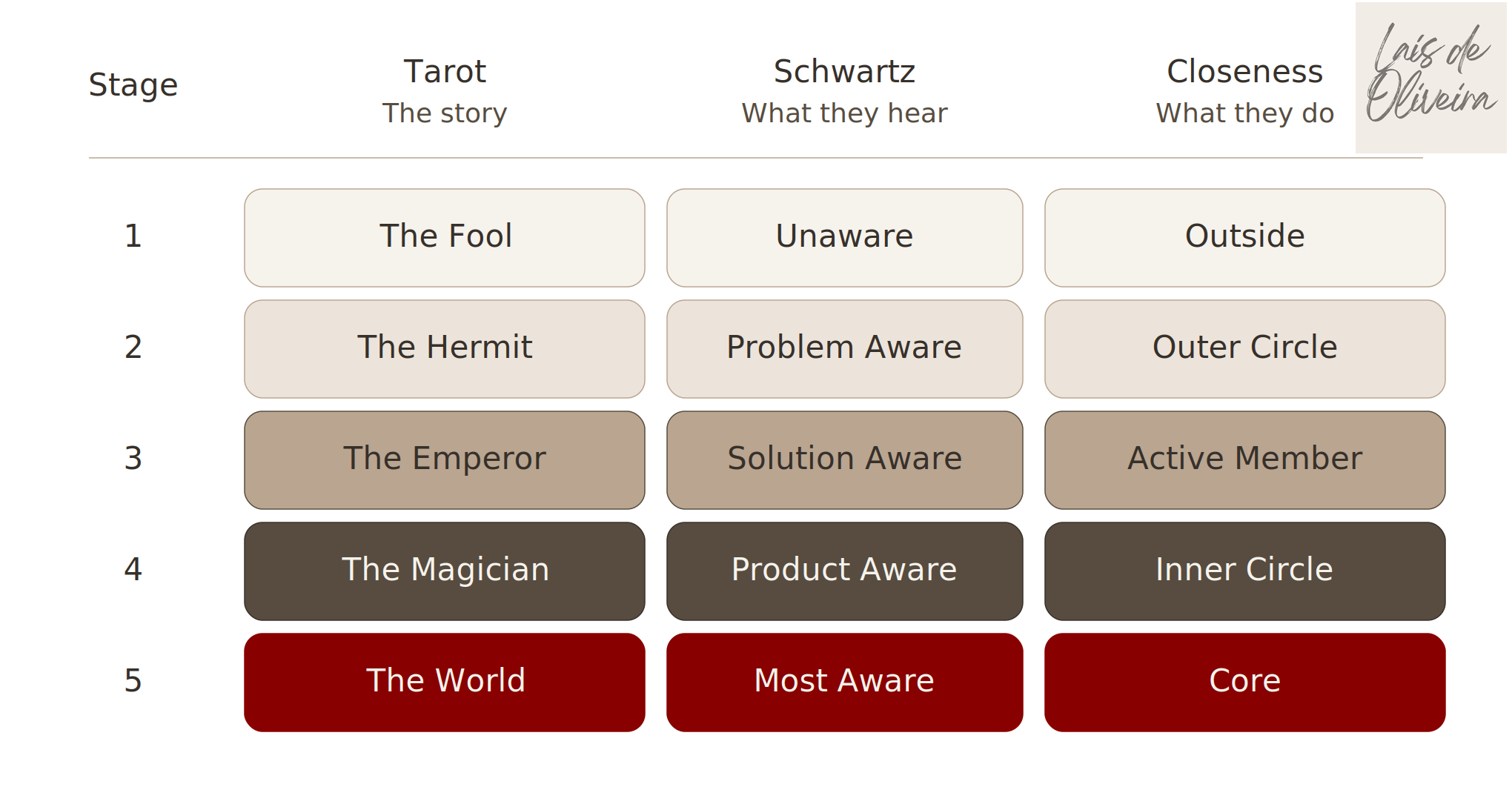
Three readings of one journey.
Tarot gives you the story. Schwartz gives you what they are ready to hear. Closeness gives you how close they feel to your brand - and how ready to partake in its growth.
All three move outward to inward.
One caveat to be aware of: Schwartz is cognitive (awareness), Closeness is relational (community). They tend to move together, but not always. Someone can be Most Aware of his problem and still be a stranger to your community. Just something to note.
A Quick Detour: Why Tarot Archetypes?
Archetypes are stories long-held in the collective unconscious, silently waiting like seeds in winter: you forgot or didn’t know they were even there, but faced with the warm hit of spring they burst through the ground and bloom.
Talk of archetypes sounds esoterically risky in a strategy meeting. But it’s worth it: archetypes awaken a deeper-than-yesterday common understanding and enable instant alignment.
The Fool is a person you already know: that enthusiastic figure stepping onto a journey unknowing the hurdles ahead. You’ve probably seen many, or been at the Fool stage before.
Similarly, once a teammate sees a Fool, they don’t need a detailed Persona that requires explaining. They see something they recognize within themselves or in others. They see a moment in their lives where they jumped into something new with excitement, only to fall off a cliff shortly after. They understand beyond a thousand words within one picture.
The archetypal stages make it memorable. Not only they help you recognize patterns, it helps you learn to speak the same language with your team. Faster.
A note on adapting this framework
One caveat: I have workshopped this journey with different business cases and believe that each case may call for different archetypes.
From my experience, the more likely archetypes to change are the ones from stages three and four, respectively the Emperor and the Magician for GigU where clarity, decision making, and mastery are the core aspects of their individual transformation towards success.
For instance: if we’re talking about a parent’s journey into deciding the best feeding solution for their newborn’s sensitive tummy, the ultimate archetype of success may be something like The Star or The Empress (archetypes of abundance, nourishment, satiety, health, and rest).
But stay with me — that’s worth another piece.
The Mechanics: How This Becomes Your GTM
Once you can name the stages, you stop guessing about four things at once.
WHO your people are: grounded in real research, not personas built from internal pattern-matching. In GigU’s case, the lifecycle model is sharp because it came out of thousands of drivers’ data points paired with qualitative research: 20+ hours of driver calls in parking lots across Texas and Florida, plus hundreds of detailed survey responses.
Not from a whiteboard. The lifecycle reflects the reality of the people it describes, and the work done to retrieve and depict it.
HOW (WHEN and WHERE) to find them: at the archetypal stage they’re actually in, not the one your funnel wishes they were in. Someone at the Fool stage who hasn’t yet realized they have a problem cannot hear “beat the algorithm.” A user at The World will roll their eyes at the entry-level pitch. Messaging matters.
Channels match the stage. They map onto a three-tier model from Hacking Communities: Lighthouse, Port, City.
The Lighthouse is the wide beam. You’re trying to be findable to people you’ve never met, broadcasting into the dark. Search results, app stores, content platforms, public communities — places that reach people before they know your name. (For GigU: YouTube tutorials, App Store listings, Reddit threads, Delivery TV.)
This is where Fools and Hermits arrive.
The Port is the recurring meeting place. Once someone knows your name and has adopted your solution, the question becomes whether you keep showing up. Group chats, regular meetups, learning sessions, physical or virtual places people can come back to. For GigU: the product itself. But also internal community forums and local gatherings.
The Lighthouse is a signal. The Port is a habit.
This is where Emperors and Magicians live.
The City is the inside. The people in the City aren’t just customers: they’re contributors to your roadmap, your support layer, your local presence. Ambassador programs, captains, advisory cohorts, beta tester networks. The Lighthouse finds them. The Port keeps them. The City makes them feel like the place was always partly theirs.
This is where The World lives.
Most teams overinvest in Lighthouse and underestimate everything else (classic vanity-metrics-led social media strategy).
But the whole point of building a Lighthouse is to attract people to a City — knowing most people will need to go through a Port, a low-stakes, low-commitment opportunity to test and learn first.
It’s the equivalent of walking them through the entire Success Journey:
Tarot: From The Fool to The World
Schwartz: From Unaware to Most Aware
Hacking Communities: From Outside to Core
That’s where network effects compound.
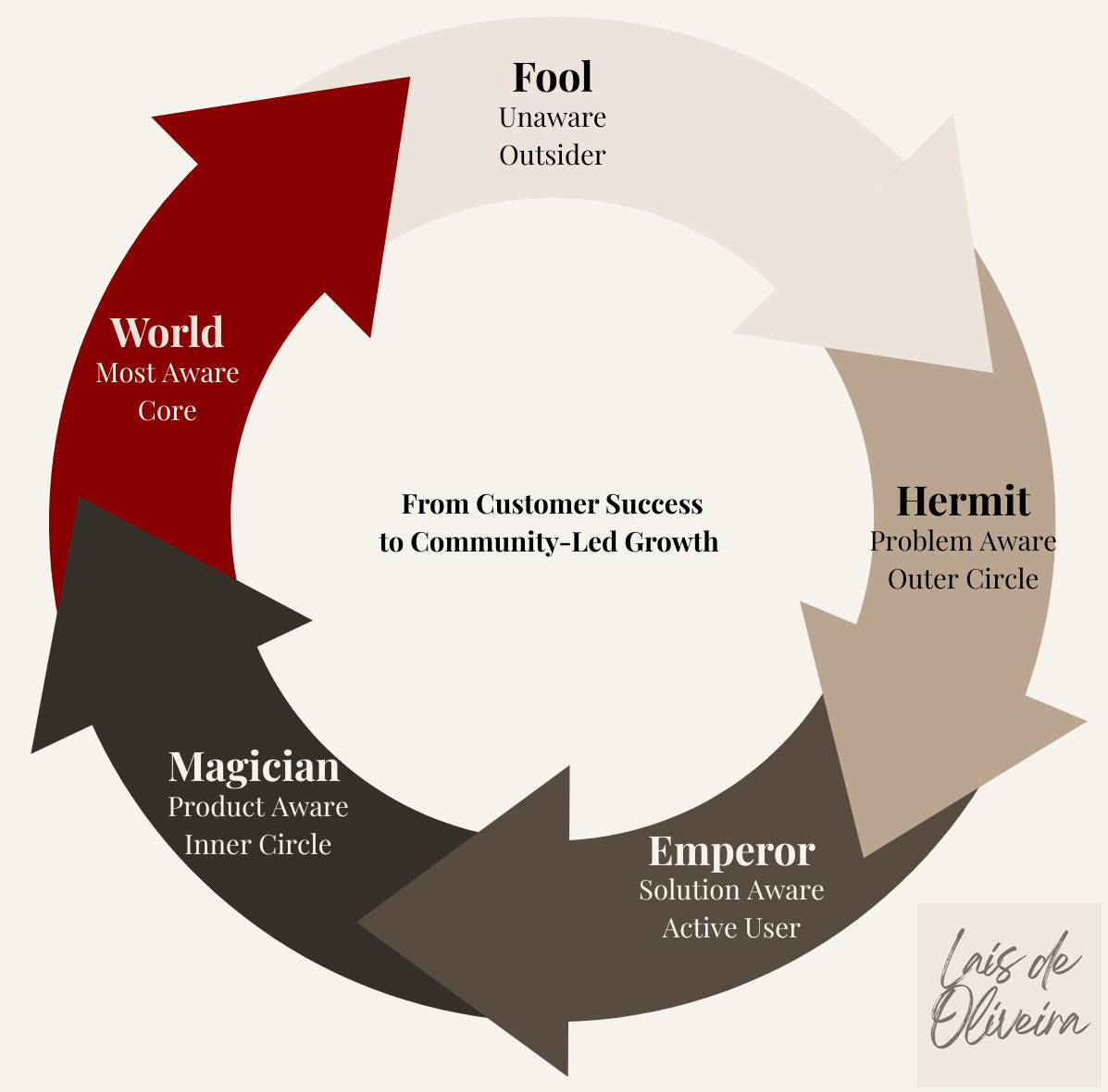
In doing the above, the flywheel builds itself - let’s see it.
Where Engineering Serendipity Comes In
Here’s where it stops being a funnel and becomes a flywheel.
The people who’ve reached The World (the same ones who crossed the threshold of the Port and entered the City) are critical to your growth. Not because they’re loyal customers: because they can shorten the journey for the next Fool who walks in. They’ve crossed a line. Jay-Z said it best: “I’m a hustler, homie. You a customer, crony.” Said with compassion, not condescension. They’ve been on the other side of that line, and they remember the journey.
Take one of our core users. Nine years on Uber in Miami, one of the first to identify critical bugs for the GigU team, still recommending GigU at airports. Asked why he keeps showing up, his answer is exact: I just want other drivers to know what I know.
That’s the World stage in one sentence.
And that’s why these users matter so much. They’re not just your biggest fan. They’re your growth engine. They don’t just attract new users, they reduce churn.
Every meetup they host, every screenshot they share, every late-night reply to a stranger in a forum collapses someone else’s Hermit stage from six months to six days.
There is no shortcut to the journey, but community makes it smoother.
Engineering serendipity, in this model, is about designing the touchpoints (meetups, ambassador calls, city groups, group chats) so that someone in the Hermit stage can collide with someone in The World and skip months of solitary searching.
The City welcomes the Lighthouse.
The Port keeps making excuses for everyone to come back, meet again.
The flywheel pulls from inside out.
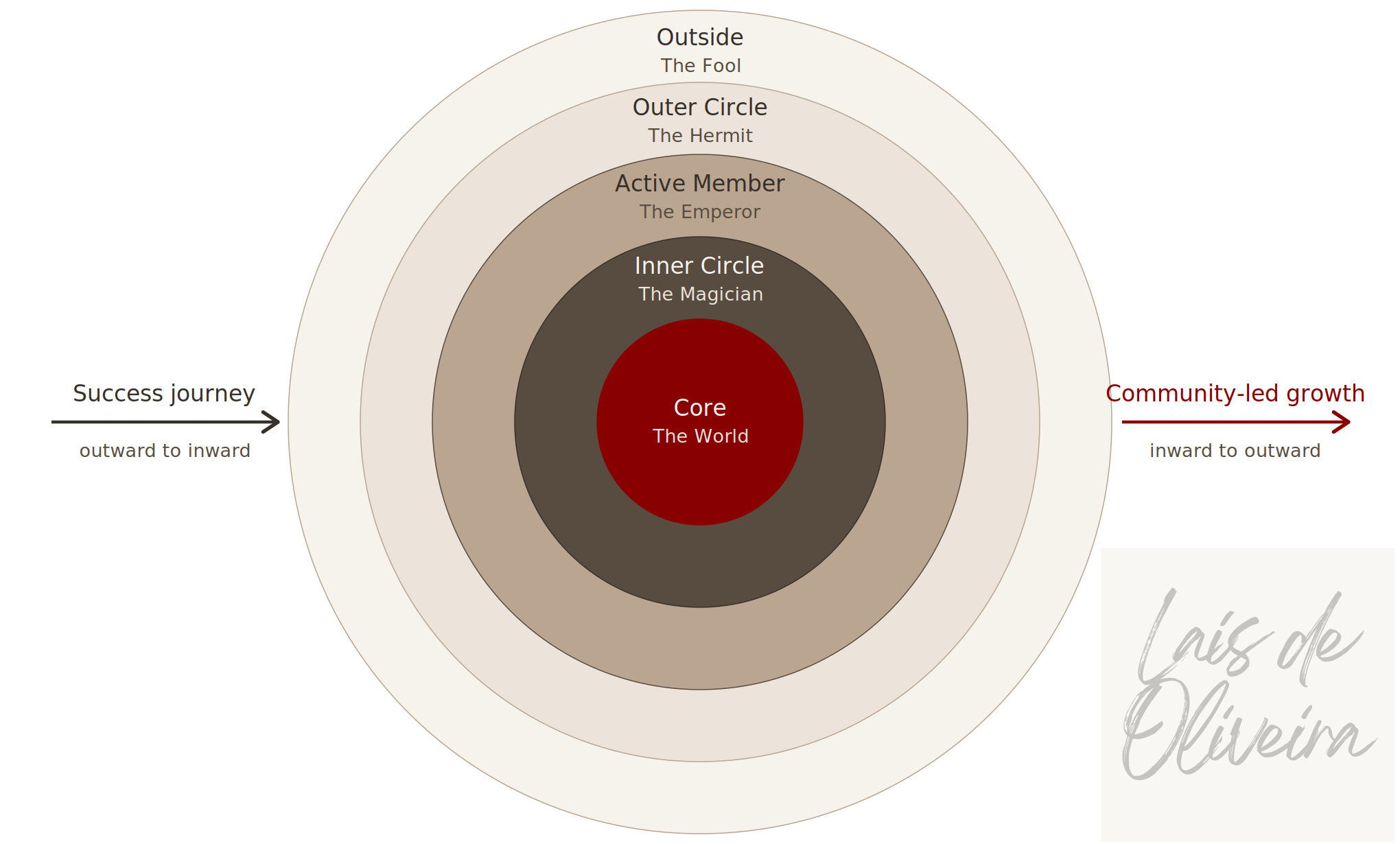
Every stage produces an artifact, an action, or a presence that pulls the next round of newcomers through their own journey faster. The journey, for the next person, is no longer a solo expedition.
This is what community-led growth actually is. Not a marketing channel, not a chatty group chat. A flywheel so inherent to your customer success journey that it makes community indispensable: a self-sustaining force that operates like gravity and magnetism, where the people deepest in the journey are the ones pulling the next round of newcomers through.
Conclusion: Quick Hack? There Isn’t One
The hack in Hacking Communities was never a shortcut.
It's about cracking the code, breaking it down to the elements most fundamental to community building. It’s about becoming the person who can build it.
Customer success becomes go-to-market for the same reason a community-built movement outlasts a paid acquisition channel: the journey makes the person. The person makes the movement.
The hack is becoming the person who can meet others where they are, because you've walked it yourself. Either you've been there, or you've built the instruments to understand it (customer development research) and the power to care (empathy) in a systematic way. The best community builders are empathetic systems thinkers.
You can't shortcut the Hermit stage, but you can channel it into community.
And as you guide them toward success, the World's stage, you nurture the next round of guides and advocates. Advocates who'll help future Fools name the problem faster. Guides who'll walk beside the next Hermit, so the path is smoother.
This is what community-led growth means in practice.
It means treating customer success as the engine, not the appendix. It means meeting people at the stage they're in, and getting your own people involved in guiding them there. It means investing in the City — the people who’ve crossed the journey — because they’re the ones who shorten the path for the next Fool who walks in.
The more intricate the journey, the stronger the movement.
And that flywheel is worth it.
Reminder: This piece extends an argument I made earlier: the strongest community-led businesses skyrocket when community isn’t an accessory, but fundamental to their value creation engine. It’s also part of a series: “Field Notes: Building a Community-Led Growth Engine from the Ground Up.” Read first post here.
Source: Gridwise 2026 Annual Gig Mobility Report; Legal & General US Gig Economy Study."
I’m a fractional Head of GTM at GigU, a data intelligence platform for gig economy drivers: the people driving your Uber, delivering your DoorDash, moving through cities in ways that are invisible to most of us until we need a ride. GigU helps them make smarter decisions about which rides to accept by surfacing the information that platforms deliberately withhold. Think of it as a copilot: not telling drivers what to do, but giving them the intelligence to decide for themselves.
I'm also the author of Hacking Communities, a field guide to building movements grounded in belonging. I write about leadership development, community-led growth, customer journeys, and the work of becoming someone who builds things that last.