

The main goal of a community manager is to become obsolete: enabling relevant interactions to continue as the community expands beyond their reach. Achievement is found by trusting its participants to moderate each others’ actions.
A community that depends on a few specific individuals to gather, interact, and create value to each other has a limited growth potential.
Enabling people to self-moderate is crucial as your community expands beyond one-person’s management capacity. In this article, we’ll explore a concept derived from inherently self-regulated communities: community etiquette.
Why self-moderation matters
To grow community exponentially, self-moderation wins over micro-management because it enables interactions to continue more efficiently and sustainably.
As a community succeeds in growing, how can managers effectively ensure that everyone continues to respect its core principles and purpose and consequently enabling positive interactions that stay relevant and are increasingly valuable?
Most self-moderated communities have long established processes and systems that enable individuals to interact and add value to each other continuously, even when no one else is pushing them to. But great leaders go beyond creating a platform and frameworks for people to interact: they delegate a sense of purpose, plus the power (and responsibility) for the community to continue existing and growing over time.
Self moderated communities reflect a deep sense of community etiquette.
What is community etiquette
If the goal of a great community leader is to become obsolete, community etiquette is the tool that enables your community to live on, beyond your reach.
In practice, self-moderation means delegating to its participants the power (and the responsibility) to keep their actions aligned with their shared purpose and principles.
et·i·quette
/ˈedəkət,ˈedəˌket/
noun
the customary code of polite behavior in society or among members of a particular profession or group.
Community etiquette is the organically coordinated effort to ensure stewardship of the collective good with the goal of increased benefit for a majority of participants. It’s very close to what I defined as “culture” in Hacking Communities (2020):
“A (community) founder’s core is made of beliefs and values that steer the decision-making process, define their actions, and influence individual behavior. Collectively speaking, this compound of behaviors driven by group values is what we call culture."
The idea of etiquette is commonly seen across activities that imply people having fun in performing an individual activity at a shared, limited space, aka: just a few can go at the same time, everyone is excited to go.
Let’s take a look.
A surfer, a climber and a snowboarder walk into a bar…
If you’re a surfer landing in a new city to have fun doing what you love most, you probably know the meaning of accelerated trust. You will be more likely to immediately bond with anyone carrying a surfboard or watching the waves.
It’s like you share a common secret and speak a different language.
A good example is how surfers unite in the face of a raging storm.
STORM WARNING!
Everybody: stay safe at home!
Surfers: omg let’s go! (aka “Eddie would go”).
Although usually expressed by silent rules, community etiquette speaks loudly in activities like surfing, bouldering and snowboarding - where goers are sharing a limited space defined by a wave, a wall or a trail, respectively.
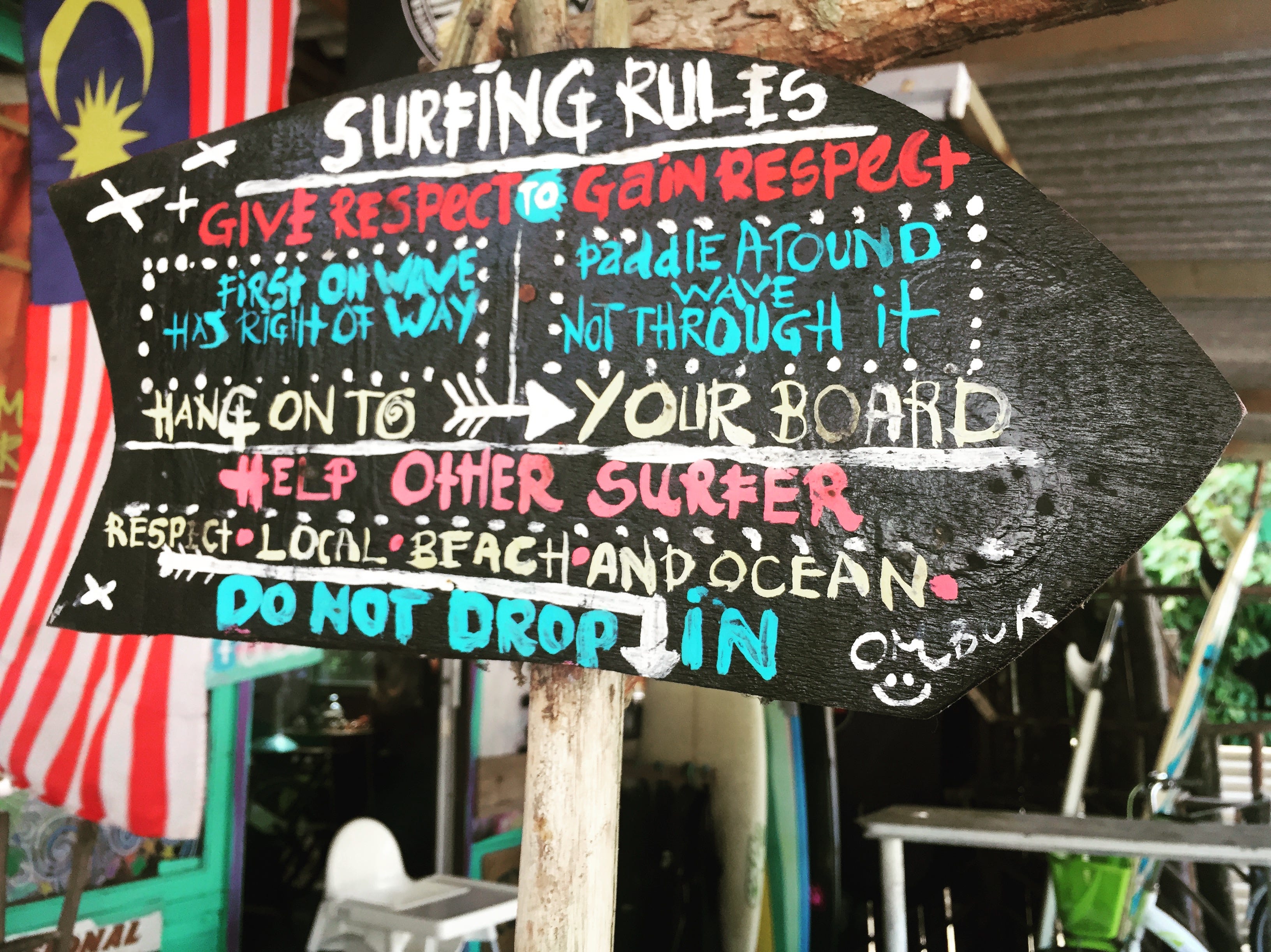
Surfing rules, for example are designed to deliver the most of the surfing experience to each individual. Those include :
Paddling around, not through a wave (so you avoid standing in the way of someone riding that wave)
Hanging on to your board (so others don’t get hit by it accidentally)
Do not drop in (also known as respect the line, don’t steal someone’s wave).
As expected, locals, regulars and older surfers are more aware of these rules than rookie surfers and often take care of informing those on how to better behave next time. I was, myself, informed of a rule I didn’t know of by a regular in the shape of a 8-year-old shredder who blatantly told me I “stole his wave”. When I came to find that he was right, I learned and incorporated that learning into my personal surfing rules.
Surfers who insist in not following these rules are not banned from the sea, but commonly shunned and might find reciprocity in other surfers not respecting their waves. If anything, they don’t make as many friends afterwards.
Both rock climbing and snowboarding share a unique set of rules as well. A newbie to those communities, I was fully onboarded from my instructors - good ones - on the etiquette to make sure everyone has fun at the mountain.
Exploring how these communities work might yield some inspiration for how you can grow your community towards a self-moderating body - that continues to follow the same principles, even when you are not around to manage it.
What do these activities have in common?
Although there’s more to these communities than simply having fun, I’d say that is at the very core of why people do it. Other common factors:
People coming together to one place (a specific point in a mountain or ocean) to have fun enjoying an individual activity;
Limited space at a time: just a given number of people (often no more than one) can go down the mountain or paddle out the same wave at the same time;
They are all there to have fun (pure love for the activity)

Other tangential commonalities are that most people travel from different places to get to a place where to perform that activity, which also implies they have a limited amount of time to enjoy it.
It’s also not uncommon that locals and regulars have an “aggro” attitude: meaning they are overly protective of “their spot”. But more often than not, people are welcoming and joyful in sharing one purpose: to have fun, one ride at a time.
Takeaways: what can we learn and practice?
A few things apply from the aforementioned examples:
Have a sharp and clear purpose to your community. Who is it designed for? Why are people participating in it? What is your core value proposition?
Define rules that enable people to better fulfill that purpose. Make sure these rules make sense. The more intuitive, the more likely your rules are sensible.
Show, don’t tell. But, also, tell. By incentivizing and rewarding positive actions, you might also indicate to people what not to do. Still, it’s always worth reminding them of your shared purpose and making rules explicit and clear in terms of how these contribute to them collectively getting the most value from being part of your community.
Bonus story: applying community etiquette
Here’s a short story and example of these ideas applied to a different type of community: one of the favorite communities I started has grown and kept itself active for over 5 years beyond my last intervention to manage it.
After an initial curation of the first 15 members, I soon delegated the power to invite in new people to a third of the initial group. It shortly grew to nearly 250 outstanding women in tech across Southeast Asia. 6 Years later, the community keeps growing and self-regulating: some women leave naturally, others are added. Posts sharing great ideas and opportunities are welcomed. Motivational, promotional or spammy posts are shunned. Vulnerable conversations about personal challenges and business-related discussions still flood my phone with notifications, once in a while. These are busy people who take valuable time to contribute to a conversation with people they never met in person.
Designed for female founders, C-Level and VCs in Southeast Asia to share growth opportunities, in the beginning I cared a lot to share a post reminding them of the purpose and basic house-keeping rules to every batch of new members. But eventually, I moved away and let the community take care of itself.
It’s been 5 years since I left Asia, and it’s still active, boasting over a third of outstanding people I’ve never met, who also have no idea who I am (or how the community began). And it doesn’t matter, as long as they align with its purpose.
While remaining a purposeful small community, I can’t help smiling by thinking about how this community has no owner, no manager.
Like the surfer community I’m so proud to be part of, as a mere participant.